A self-hosted, AI-enabled operations platform. Multi-surface orchestration
combining local and cloud LLM access, automation building, telemetry, and content
operations. Opinionated toward local ownership
rather than SaaS-style multi-user abstractions — a real cockpit for AI-assisted work.
The Operations Console is a multi-surface orchestration environment that combines
local and cloud LLM access, automation building, monitoring, and content
operations.
Local ownership. Runs on hardware you control. No SaaS abstraction layer between you and the work.
Low-friction iteration. The cockpit is alive — flows, jobs, and prompts loop in seconds, not hours.
Operator workflows. Built for the person doing the work, not the team buying the seats.
02 — StackRuntime architecture
FrontendSvelte + ViteReactive panels, hot reload, no SSR overhead
BackendExpressThin REST + WebSocket layer
RuntimeNode.js 22Single-process, event-driven
PersistenceSQLite (better-sqlite3)Local file, atomic writes, fast reads
DeploymentUbuntu / systemdUser unit on a Linux box. Restart on failure.
03 — Product surfacesFour panel families
[chat]
AI & Chat
Chat agent workspace with model routing and prompt controls. Kanban surface for idea refinement.
Chat Agent Workspace
Model Routing
Idea Refinement Kanban
[flow]
Orchestration
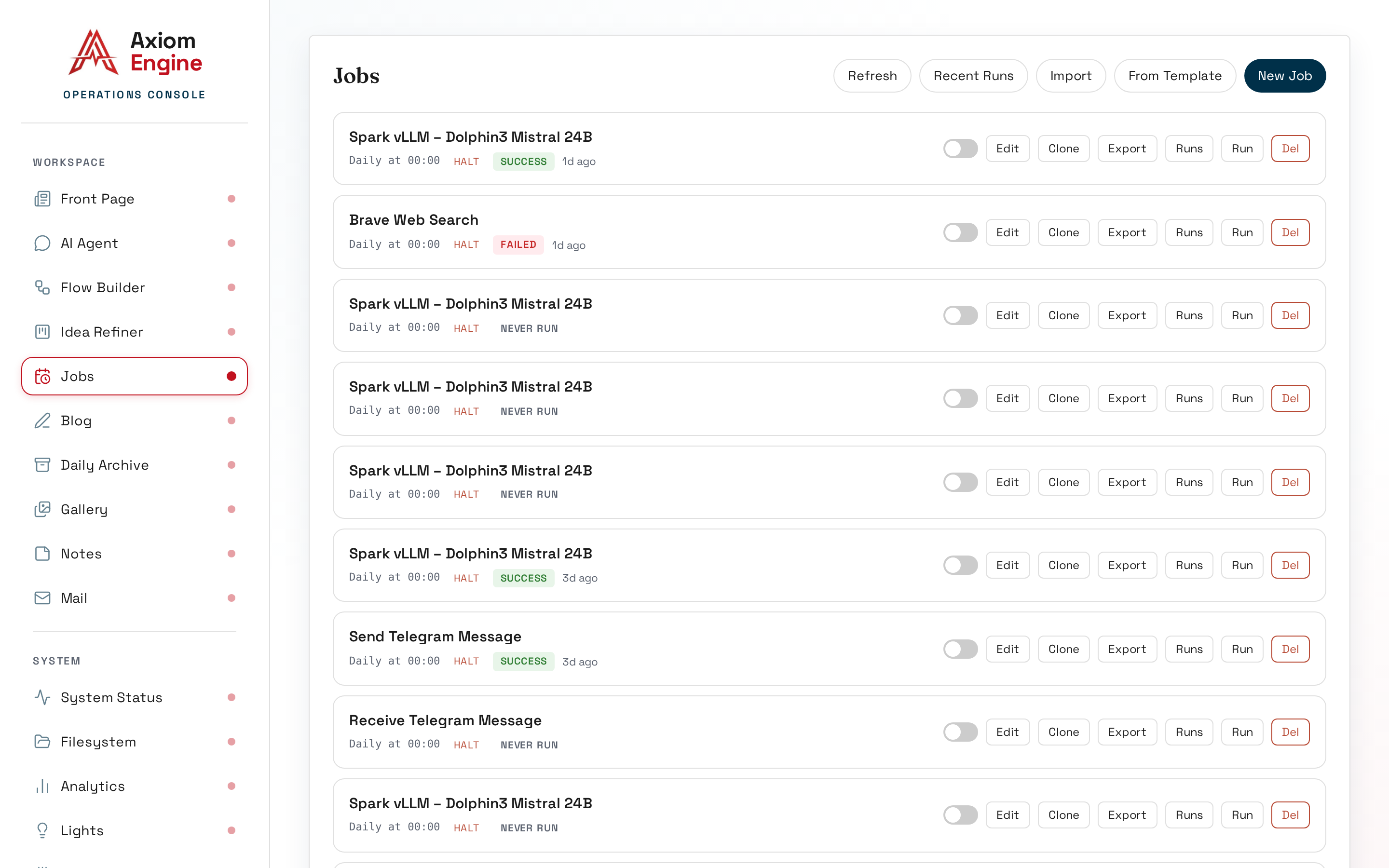
FlowBuilder visual canvas and Jobs engine for reusable skill pipelines and automations.
FlowBuilder Visual Canvas
Reusable Skill Pipelines
Jobs Engine
[data]
Data & Media
Filesystem browsing, Gallery media library, Notes capture, and URL Links registry.
Filesystem Browsing
Gallery Media Library
Notes Capture
URL Links Registry
[infra]
Infrastructure
System status, smart-home Lights, and compute-oriented Processing control surfaces.
The system supports a hybrid topology: OpenAI, Anthropic, local Ollama, and
Spark-hosted custom vLLM and ComfyUI servers. Every token, local or cloud, flows
into the same analytics substrate.
Sequential, parallel, loops, conditionals. Every step is a typed,
addressable thing — observable, retryable, and recombinable. The cron layer
turns any pipeline into a scheduled background process without leaving the cockpit.
cron-schedulerTime-based triggers
cron-ai-builderLLM-authored job composition
cron-self-healFailure auto-recovery
cron-intelligent-retryBackoff with state preservation
06 — Flow builder layerGraph orchestration
Graph-based composition with typed connectivity
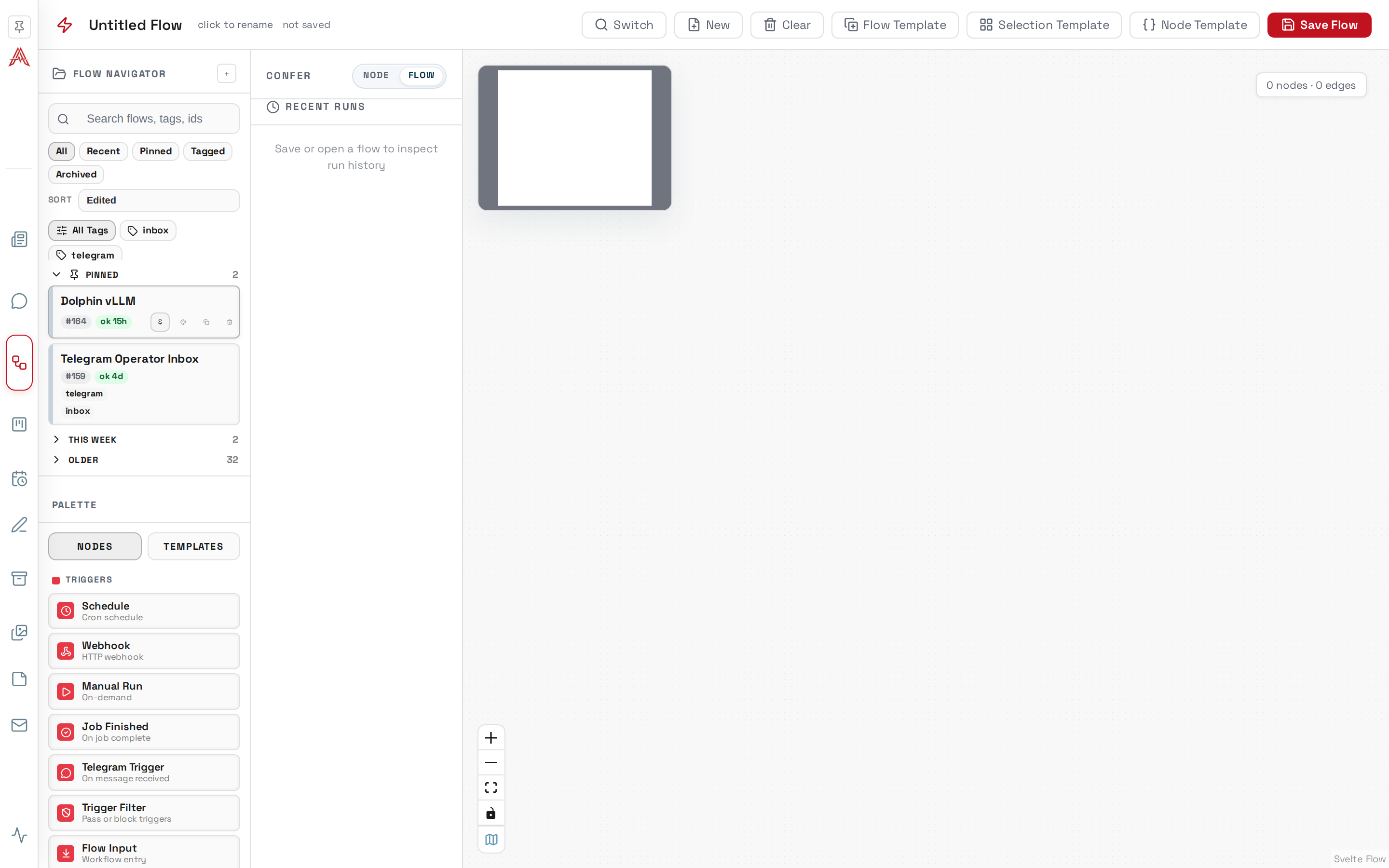
Branching, looping, and workflow composition on a Svelte Flow canvas. Nodes
carry a stable type contract; connections carry shape. The flow you build at
08:00 runs at 23:55 and looks the same — because the connections were never
implicit.
flow-executorServer-side runner
flow-triggerWebhook & cron entry
flow-node-runtimePer-node type system
flow-versioningDiff & rollback
localhost:5173 · /flow · Spark TTS
screenshot pending — run npm run harvest:axiom
07 — Telemetry & analyticsOperational tracking
Current analytics cover run volume, status distribution, token usage, cost
estimates, and model durations — with local-vs-cloud distinctions preserved. The
shape of what gets surfaced publicly lives at /metrics.
Run volumePer flow, per cron job, per day
Status distributionSuccess / failure / running, with drill-down
Outbound is fully functional — plain text and media attachments. Inbound
foundations exist via webhook handling. The plan: a reusable "Telegram Bot Agent"
pattern, structured-input normalization for flow outputs, and a memory model
parameterized by store_name so each conversation can carry its own continuity.
telegram.sendStable
telegram.mediaStable
telegram.webhookIn progress
telegram.bot-agentPattern emerging
09 — Vision: 8 in, 1 outStrategic pillars
I
Unified memory spaces
Scattered thoughts fuse into a single, intuitive intelligence the agent can reason across.
II
Multi-tiered system logs
The silent architect of agentic debugging — structured, unbreakable, the only truth-teller in chaos.
III
Self-healing retry routines
Persistent, intelligent retries that auto-capture every state shift in the flow.
IV
Cross-workflow data flow
The catalyst that shatters silos and turns fragmented operations into a single, intelligent engine.
V
Modular components
Every component breathes independently. The escape hatch from spaghetti hell.
VI
Faster than real-time
Neural engines that devour streaming torrents with zero latency.
VII
Living navigation
Every click triggers a cascade of micro-affordances that feel like the surface itself is alive.
VIII
8 in, 1 out
Eight strategic pillars converge into a single coherent operator surface.
10 — Current maturityAs of May 2026
The console is no longer at prototype stage. It is an advanced working state with
real capabilities and an increasingly coherent design system. The focus is now on
tightening information density and interaction speed.
Jobs & skills executionMature
Flow orchestration foundationStable
Local/cloud LLM integrationStable
Analytics & telemetryAdvanced
Telegram outboundStable
Telegram inbound (webhooks)In progress
Multi-store memory parameterizationIn progress
Public metrics surfaceIn progress
11 — The road aheadNext 12 months
The next twelve months are about consolidation, not expansion. Three priorities,
in order:
Flow builder maturity. Custom node authoring becomes
first-class. The graph layer becomes the primary composition substrate for
everything in the cockpit.
Memory that survives sessions. A deeper memory model with
parameterized stores, durable across restarts, queryable across flows.
Public metrics surface. The /metrics
page becomes the operator's public résumé — turning private telemetry into
shareable narrative without leaking proprietary detail.
Status: active deployment · maintained by Anders Jensen · andersjensen1.com